







Home Destinations Skiing Lodging Camping Activities Sightseeing Books & Maps Gear


Make A Selection

  Visit Official Website
Go Back a Page


Arches National Park

Slideshow image

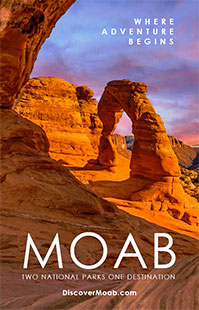
Arches National Park preserves over 2,000 natural sandstone arches, like the world-famous Delicate Arch, as well as many other unusual rock formations. In some areas, the forces of nature have exposed millions of years of geologic history. The extraordinary features of the park create a landscape of contrasting colors, landforms and textures that is unlike any other in the world.


 The Basics


Hours:

Arches is open year-round, 24 hours a day. The visitor center is open daily during the following hours:

April through October: 7:30 am to 6:30 pm
November through March: 8:00 am to 4:30 pm

The visitor center is closed on December 25th.

Address: PO Box 907
Moab, UT 84532
Phone: 435-719-2299
Phone: 435-719-2319
Fax: 435-719-2305

For more info, visit OFFICIAL WEBSITE


 Directions

The entrance to Arches is located 5 miles north of Moab, UT along Highway 191.


 Climate
 

Summer temperatures (June through September) may exceed 100° Fahrenheit. Winter temperatures (December through February) often drop below 32° Fahrenheit. Temperatures may range 50° in a 24-hour period.

Link to our Canyonlands National Park Weather coverage for more information.

Link to our Colorado River Weather coverage for more information.

Link to our Green River (town of) Weather coverage for more information.

Link to our La Sal Mountains Weather coverage for more information.

Link to our Moab Weather coverage for more information.

 Fees
 

Individuals: $5 (Good for 7 Days)
Vehicles: $10 (Good for 7 days)


 Reservations
 

Please call for group reservations


 Things To Do
 

Have a limited time to explore Arches? Here are some suggestions to help you make the most of your visit, even if it is brief.

If You Like to Hike

Time allocations are based on an average hiking speed of two miles per hour, and include time to drive to the trailheads. (Time spent marveling and contemplating the majestic wonders and sights varies greatly and is not included here.) Add time to take in the scenery from roadside pullouts between destinations.

In two hours, you can do one of these four routes:

  • Hike the Windows loop trail and get an up-close view of the North and South Windows and Turret Arch. Then take the short trail between parking areas and hike up to Double Arch. Drive back to Balanced Rock and take the loop trail around its base. Contemplate its precarious position as you walk beneath it.
  • Take the Delicate Arch Trail from Wolfe Ranch up the sloping slickrock to stand under the best known arch in the world. (During hot months, do this hike early or late in the day.)
  • Hike between the tall sandstone fins in the Devils Garden to see Landscape Arch, perhaps the world’s longest. How long will this thin span resist the forces of gravity?
  • Walk to Sand Dune Arch, across the grassy field and onward to Broken Arch. Continue around the loop, through the end of the campground, and return. Enjoy the vista toward the distant Book Cliffs, the beautiful Tapestry Arch and the sandstone fins.

In half a day, take one of these three hikes:

  • Hike the entire Devils Garden Trail, all the way out to the spire called Dark Angel. When you return, take the primitive loop.
  • Take the moderately strenuous ranger-guided hike through the the Fiery Furnace. Sign up ahead of time at the visitor center.
  • If you don’t mind driving the rough and often “washboard” road to the remote island of rock known as Klondike Bluffs, hike the primitive trail to Tower Arch. If you have a whole day or more, combine the above hikes to fill the time you have.

If You Like to Tour by Car

In 1 1/2 hours you can take one of the following routes:

  • Drive to the Windows Section and see some of the park’s largest arches. (Add one-half hour to stroll beneath either North Window or Double Arch.)
  • Drive to the Delicate Arch Viewpoint and see the world’s most famous arch, a mile distant. Stop at Wolfe Ranch on your way back and imagine what it would have been like to homestead this relatively barren area in the late 1800s. Three hours will give you time to do both drives. (Or you could do one drive, spending ten minutes at each viewpoint along the way.)

If you have 4 1/2 hours:

You could drive all of the paved park roads, spending ten minutes at each viewpoint, and take quick drives to the Windows Section, Wolfe Ranch, and Delicate Arch Viewpoint.

Can’t decide?

Well, forget the schedule and stay another day. If you try to see too much on your vacation, you end up really “seeing” nothing.


 Outdoor Camping
 

The Devils Garden Campground is located eighteen miles from the park entrance and is open year-round. Facilities include potable water, picnic tables, grills, as well as both pit-style and flush toilets. There are no showers. Bring your own wood or charcoal for the grills. Some sites will accommodate RV's up to 30 feet in length.

Telephone and on-line reservations for both group and individual sites may be made through www.recreation.gov. Reservations are not accepted by the park, and the park does not maintain information about site availability.

Individual Sites
The campground has 52 individual sites which are $15 per night and will accommodate up to ten people. Up to 28 of the individual sites may be reserved for nights between March 1st and October 31st. Reservations must be made no less than 4 days and no more than 240 days in advance. There is an additional $9 booking fee for reservations. To make a reservation, visit www.recreation.gov, or call (877) 444-6777, (877) 833-6777 (TDD), or (518) 885-3639.

The remaining 24 campsites are available on a first-come, first-served basis each day beginning at 7:30 a.m. at the park entrance station or visitor center.

Group Sites
The campground has two sites for groups of eleven or more people. The Juniper Basin campsite will accommodate up to 55 people; the Canyon Wren campsite up to 35. The group camping fee is $3 per person per night, with a $33 per night minimum. No recreational vehicles or trailers are permitted in the group sites.

Group campsites may be reserved year-round. Reservations must be made no less than 4 days and no more than 360 days in advance. There is an additional $9 booking fee for reservations. To make a reservation, visit www.recreation.gov, or call (877) 444-6777, (877) 833-6777 (TDD), or (518) 885-3639.

Unreserved group campsites are available on a first-come, first-served basis on the day of arrival.

Other Camping Options
The Bureau of Land Management (BLM) operates many campgrounds in the Moab area. Some accommodate large groups and may be reserved in advance.

Link to our Canyonlands National Park Camping coverage for more information.

Link to our Colorado River Camping coverage for more information.

Link to our Green River (town of) Camping coverage for more information.

Link to our La Sal Mountains Camping coverage for more information.

Link to our Moab Camping coverage for more information.

 Hiking
 

Backing

Arches is a relatively small park, with very few areas far enough from roads to qualify as backcountry. Outside the developed areas there are no designated trails, campsites, or reliable water sources.

In order to backpack in Arches, you must obtain a free backcountry permit at the visitor center. The maximum group size is twelve, but smaller groups are strongly recommended to reduce impacts. Permits may not be reserved in advance. Backpackers should know how to navigate with a topographic map, recognize safety hazards and practice low-impact camping specific to the high desert. Primary safety considerations include steep terrain, loose rock, lightning, flash floods, and dehydration.

Hiking

Arches contains a wealth of hiking trails. Ranging in length and difficulty, these trails provide access to outstanding viewpoints and many of the park's famous features, including Balanced Rock and Delicate Arch. In many cases, trails travel under arches, affording quite a different perspective than what is visible from a car.

Easy Trails

Balanced Rock
Starting Point: Balanced Rock parking area
Length: 0.3 mi/0.5 km round trip
Time: 15 to 30 minutes

A loop trail around the base of a fragile, picturesque rock formation.

Broken Arch
Starting Point: Sand Dune Arch parking area or Devils Garden campground across from campsite #40
Length: 1.2 mi/2 km round trip; 2 mi/3.2 km including the loop
Time: 30 to 60 minutes

From the Sand Dune Arch parking area, the trail cuts across a large meadow to the arch and continues to the campground. Loop trail leads through fin canyons with sand dunes and slickrock.

Delicate Arch Viewpoin
tStarting Point: Delicate Arch Viewpoint parking area
Length: 100 yards (91 meters) round trip
Time: 10 to 15 minutes

In addition to the short accessible trail, another (moderately strenuous) hiking trail climbs one-half mile (0.8 km) toward Delicate Arch and ends at the rim of a steep canyon that separates the viewpoint from the arch. (This is not the popular trail to Delicate Arch, which starts at the Wolfe Ranch parking area.)

Double Arch
Starting Point: Double Arch parking area
Length: 0.5 mile (0.8 km) round trip
Time: 15 to 30 minutes

A relatively flat, sandy trail leads to the base of two giant arch spans which are joined at one end.

Landscape Arch
Starting Point: Devils Garden trailhead parking area
Length: 2 miles (3.2 km) round trip
Time: 30 to 60 minutes

A relatively flat, gravel-surfaced trail (usually heavily populated with hikers) leads to a spectacular ribbon of rock, whose span is more than a football field in length. Short side trips to Tunnel and Pine Tree Arches. Trail guide available at trailhead.

Sand Dune Arch
Starting Point: Sand Dune Arch parking area
Length: 0.4 mile (0.6 km) round trip
Time: 15 to 30 minutes

Trail leads through deep sand to a secluded arch among sandstone fins.

Skyline Arch
Starting Point: Skyline Arch parking area
Length: 0.4 mile (0.6 km) round trip
Time: 10 to 20 minutes

A short hike on a flat, well-defined trail. On a cold November night in 1940, a large chunk fell out of the arch, instantly doubling the size of its opening.

The Windows
Starting Point: Windows parking area
Length: 1 mile (1.6 km) round trip
Time: 30 to 60 minutes

A gentle climb up a gravel loop trail leads to three massive arches (North and South Windows and Turret Arch). An alternate return, slightly longer, is by way of the primitive loop around the back of the two Windows. The primitive loop trail starts at the South Window viewpoint.

Moderate Trails

Park Avenue
Starting Point: Park Avenue parking area
Ending Point: Courthouse Towers parking area
Length: 1 mile (1.6 km) one way
Time: 30 to 60 minutes
Elevation change: 320 feet (98 meters)

From Park Avenue parking area, the trail descends steeply into a spectacular canyon and continues down the wash to Courthouse Towers. If you have a shuttle driver, you can begin at one point and be picked up at the other. For round-trip hiking, retrace your steps along the trail rather than walk along the park road.

Tower Arch
Starting Point: Klondike Bluffs parking area, via the Salt Valley road
Length: 3.4 miles (5.6 km) round trip
Time: 2 to 3 hours

The trail climbs a steep, but short, rock wall, cuts across a valley and then meanders through sandstone fins and sand dunes. An alternate, shorter trail (0.3 mile [0.4 km] one way), begins at the end of the four-wheel-drive road on the west side of Tower Arch. This unpaved road washes out quickly in rainstorms; inquire at the visitor center about road conditions before heading out.

Long Trails

Delicate Arch
Starting Point: Wolfe Ranch parking area
Length: 3 miles (4.8 km) round trip
Time: 2 to 3 hours
Elevation change: 480 feet (146 meters)

Take at least 1 quart (1 liter) of water per person! There is no shade. Open slickrock with some exposure to heights. The first half-mile is a wide, well-defined trail. Upon reaching the slickrock, follow the rock cairns. The trail climbs gradually and levels out toward the top of this rock face. Just before you get to Delicate Arch, the trail goes along a rock ledge for about 200 yards.

Devils Garden Primitive Loop
Starting Point: Devils Garden Trailhead parking area
Length: 7.2 mi/11.5 km round-trip, including all points of interest
Time: 3 to 5 hours

Longest of the maintained trails in the park, the Devils Garden Trail leads to eight awe-inspiring arches. Expect narrow ledges with rocky surface hiking and scrambling on slickrock. Not recommended when rock is wet or snowy. Trail guide available at trailhead.

Double O Arch
Starting Point: Devils Garden Trailhead parking area
Length: 4 miles (6.4 km) round trip
Time: 2 to 3 hours

Beyond Landscape Arch, the trail becomes more challenging as it climbs over sandstone slabs; footing is rocky; there are narrow ledges with exposure to heights. Spur trails lead to Partition and Navajo Arches. Dark Angel is one-half mile (0.8 km) farther. Trail guide available at trailhead.

Fiery Furnace

The Fiery Furnace is a labyrinth of narrow sandstone canyons and fins. There are no marked trails and the area has suffered resource damage due to increased visitation. Hikers who want to explore the Fiery Furnace must obtain a permit at the visitor center (fee charged) and watch a minimum impact video. All visitors are encouraged to sign up for a ranger-guided hike.

Link to our Canyonlands National Park Hiking coverage for more information.

Link to our Colorado River Hiking coverage for more information.

Link to our Green River (town of) Hiking coverage for more information.

Link to our La Sal Mountains Hiking coverage for more information.

Link to our Moab Hiking coverage for more information.

 Outdoor Climbing
 

The rock at Arches offers excellent climbing opportunities, despite its sandy nature. Most climbing routes in the park require advanced techniques. Permits are not required, unless the trip involves an overnight stay in the backcountry. Climbers are encouraged to access climbing routes via established trails, slickrock or sandy washes.

It the responsibility of all climbers to know and obey park regulations and route closures. The following closures, conditions, and restrictions apply to rock climbing or similar activities such as, but not limited to, technical rock climbing, free climbing and clean aid climbing within Arches National Park:

Closures

  • Any arch or natural bridge named on the United States Geological Survey 7.5 minute topographical maps covering Arches National Park is closed to climbing year-round.
  • Balanced Rock- Closed to climbing year-round.
  • Bubo- Closed from January 1st to June 30th.
  • Industrial Disease on the Devil Dog Spire is closed from January 1st to June 30th.
  • Slacklining is prohibited anywhere within Arches National Park year-round.

Restrictions

  • No new permanent climbing hardware may be installed in any fixed location. If an existing bolt or other hardware item is unsafe, it may be replaced. This will limit all climbing to existing routes or new routes not requiring placement of fixed anchors.
  • Climbing anchors and/or protection points may not be placed with the use of a hammer except to replace existing belay and rappel anchors and bolts on existing routes, or for emergency self-rescue.
  • If an existing software item (sling, runner etc.) is unsafe, it may be replaced.
  • Software (webbing, accessory cords, etc.) that is left in place shall match the rock surface in color.
  • The intentional removal of lichen or plants from rock is prohibited.
  • The physical altering of rock faces such as chiseling, glue reinforcement of existing holds, and gluing of new holds is prohibited.
  • The use of motorized power drills is prohibited.
  • Fixed ropes may not be left in place for more than 24 hours. Fixed ropes left in place longer than 24 hours shall be considered "abandoned property" and removed.
  • The use of chalk for climbing must be of a color that blends with the native rock.

Definitions

Technical Rock Climbing is defined as ascending or descending a rock formation utilizing rock climbing equipment.

Free Climbing and Clean Aid Climbing are minimum impact approaches that employ chocks, stoppers, nuts and camming devices, rather than pitons or bolts, for protection or direct support. These are climbing aids that are removable and do not damage the rock.

Slacklining is defined as walking on a rope or other line that is anchored between rock formations, trees, or any other natural features. Height of the rope above the ground is immaterial.


 Guided Tours
 

The road system in Arches passes many outstanding natural features. As Arches' popularity has increased, people have begun to park in areas that damage plants and sometimes endanger other visitors. Please park in established lots only. Generally, parking spaces are easier to find before 9 a.m. and after 7 p.m.

If your time at Arches will be limited, try one of the following itineraries:

If you have 1.5 hours
Drive to the Windows Section and see some of the park's largest arches. (Add one-half hour to stroll beneath either North Window or Double Arch.). Alternatively, drive to the Delicate Arch Viewpoint and see the world's most famous arch, a mile distant. Stop at Wolfe Ranch on your way back and imagine what it would have been like to homestead this relatively barren area in the late 1800s.

If you have 3 hours
Do both of the above!

If you have 4.5 hours
Drive all of the paved park roads, spending ten minutes at each viewpoint, and be sure to visit the Windows Section, Wolfe Ranch and the Delicate Arch Viewpoint.


 Biking
 

Arches offers great opportunities for both road and mountain biking. Though there are no bike lanes and traffic can be heavy at times, biking the scenic drive is a great way to see the park. The Salt Valley and Willow Springs roads are less traveled but are more suited to mountain bikes due to washboards, deep sand and other obstacles.

Bicycles are only permitted on roads: there is no single track or trail riding in the park. When biking on the main road, please use caution and ride single file on the edge of the lane.

Link to our Canyonlands National Park Biking coverage for more information.

Link to our Colorado River Biking coverage for more information.

Link to our Green River (town of) Biking coverage for more information.

Link to our La Sal Mountains Biking coverage for more information.

Link to our Moab Biking coverage for more information.

 Nearby Attractions
 

National Park Service Areas

  • Aztec Ruins National Monument
  • Canyonlands National Park
  • Chaco Culture National Historical Park
  • Glen Canyon National Recreation Area
  • Hovenweep National Monument
  • Mesa Verde National Park
  • Natural Bridges National Monument

Link to our Canyonlands National Park Attractions coverage for more information.

Link to our Colorado River Attractions coverage for more information.

Link to our Green River (town of) Attractions coverage for more information.

Link to our La Sal Mountains Attractions coverage for more information.

Link to our Moab Attractions coverage for more information.


Copyright 1998 - 2008