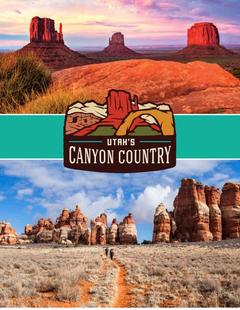








Canyonlands preserves a colorful landscape eroded into countless canyons, mesas and buttes by the Colorado River and its tributaries. The rivers divide the park into four districts: the Island in the Sky, the Needles, the Maze and the rivers themselves. While these areas share a primitive desert atmosphere, each retains its own character and offers different opportunities for exploration.
The Basics
Hours:
Canyonlands is open year-round. Each district has its own visitor center and hours may vary. All visitor centers are closed on December 25th and January 1st.
The Island in the Sky Visitor Center is open 9 am to 4:30 pm daily, with extended hours spring through fall.
The Hans Flat Ranger Station is open year-round from 8 am to 4:30 pm.
The Needles District Visitor Center is open year-round from 9:00 am to 4:30 pm, with extended hours March through October.
There are two paved entrances into Canyonlands: Highway 313 leads to the Island in the Sky, while Highway 211 leads to the Needles. Roads to the Maze are a mixture of graded dirt and 4WD. These roads may become impassable when wet.

Climate
The climate in Canyonlands is extremely dry. Most precipitation falls in early spring and late summer. Summer highs often exceed 100° Fahrenheit, with lows in the 60's. Fall and Spring temperatures are milder, with highs in the 70's and 80's. Winter temperatures range from highs in the 40's and 50's to lows well below freezing. Snow is usually light to moderate.
Individuals: $5, Vehicles: $10, Local Passport: $25 Camping fees start at $10/night
Reservations
Reservations are available for all backcountry permits and for group campsites in the Needles.
Outdoor Camping
Squaw Flat Campground Located in the Needles, Squaw Flat Campground is an ideal base camp for day hikes to popular destinations like Chesler Park, Druid Arch and the Joint Trail. There are 26 sites available on a first-come, first-served basis. Bathrooms, fire grates, picnic tables, tent pads and water available year-round. Group size limit is 10 people and 2 vehicles. Maximum RV length is 28 feet. Fee is $15 per night. Squaw Flat typically fills every day from late March through June and again from early September to mid-October.
Willow Flat Campground Located at the Island in the Sky, the Willow Flat Campground is a short walk from one of the finest sunset spots in the park: Green River Overlook. Twelve sites are available on a first-come, first-served basis. Sites include picnic tables, fire grates and vault toilets. No water. Maximum RV length is 28 feet. Group size limit is 10 people and 2 vehicles. Fee is $10 per night. Willow Flat typically fills every day from late March through June and again from early September to mid-October.
Group Sites The Needles offers three campsites for groups of 11 or more people which may be reserved in advance. The Squaw Flat Group Site can hold up to 50 people and 10 vehicles. The Wooden Shoe Group Site can hold up to 25 people and 5 vehicles. The Split Top Group Site can hold up to 15 people and 3 vehicles. Nightly fees are $3 per person.
Much of Canyonlands is managed as undeveloped land, and the park has become an increasingly popular destination for backcountry travel. Permits are required for all overnight trips in the backcountry. During the spring and fall, demand for permits frequently exceeds the number available. If you plan to visit Canyonlands during peak season, it is recommended that you make reservations well in advance.
Sites and Zones
In order to protect natural and cultural resources and prevent crowding, the backcountry of Canyonlands is divided up into sites and zones, and access to each is limited. There are designated walk-in sites along some heavily traveled hiking trails, mostly in the Needles, for use by backpackers. In more remote areas like the Maze, visitors stay in at-large zones and may choose their own campsites.
Water
Water is a limiting factor for most backcountry trips in Canyonlands. There are springs scattered throughout the park, mostly in canyon bottoms. There are also large areas, such as the Grabens in the Needles and the entire White Rim bench at the Island in the Sky, where there are no reliable water sources. Obtaining drinking water from the Colorado or Green Rivers is difficult as the water is very silty and hard to purify. Backpacking groups are encouraged to pack in water whenever possible. Many springs marked on topographic maps may dry up during periods of drought. Spring locations and current conditions are available at district visitor centers.
Hiking
Canyonlands has hundreds of miles of hiking trails which explore the park’s natural and cultural features. Both the Island in the Sky and the Needles provide ample opportunities for short walks, day hikes and backpacking trips. Due to its remoteness, the Maze is primarily a backpacking destination.
Trails are usually marked with cairns (small rock piles) and have signs at intersections. Many remote trails do not receive regular maintenance and may not be adequately marked. All backcountry hikers should carry a topographic map.
The sandstone towers at the Island in the Sky attract the most rock climbers. Little climbing is done in the rest of the park due to the poor rock quality and a lack of established routes. Permits are not required for technical rock climbing unless it involves an overnight stay in the backcountry.
Regulations
Technical rock climbing is prohibited in the Salt Creek Archeological District in the Needles, in Horseshoe Canyon, into any archeological site or cultural resource, or on any arch or natural bridge in Canyonlands National Park or the Orange Cliffs Unit of Glen Canyon NRA named on a USGS map, with the exception of Washer Woman Arch at the Island in the Sky. The intentional removal of lichen or plants from rock is prohibited. The physical altering of rock faces by chiseling, glue reinforcement of existing holds, and gluing of new holds is prohibited. The use of motorized power drills is prohibited.
All climbing shall be free or clean-aid climbing with the following exceptions:
No new climbing hardware may be left in a fixed location; however, if a hardware item is unsafe, it may be replaced.
Protection may not be placed with the use of a hammer except to replace existing belay and rappel anchors and bolts on existing routes, or for emergency self-rescue.
If an existing software item (sling, etc.) is unsafe, it may be replaced (software that is left in place must match the rock surface in color).
Canyoneering (cross-country travel involving the occasional use of climbing equipment ) may occur in areas closed to rock climbing, but must occur at least 300 feet away from cultural sites.
Guided Tours
Travel to backcountry areas requires planning, experience and equipment that is often expensive. For visitors without the resources or inclination to plan their own excursions, guided trips offer the perfect way to experience the wonders of Canyonlands.
Outdoor Boating and Fishing
Boating
The Colorado and Green Rivers have played a significant role in shaping the landscape of Canyonlands, and both offer an interesting way to visit the park. Above their confluence near the heart of Canyonlands, the rivers offer miles and miles of flat water perfect for canoes, sea kayaks and other shallow-water boats. Below the confluence, the combined flow of both rivers spills down Cataract Canyon with remarkable speed and power, creating a fourteen-mile stretch of Class III to V white water.
Private Permits
Permits are required for all overnight private river trips. Permits can be reserved in advance starting the first business day of each calendar year.
Guided Trips
Local outfitters offer a variety of guided trips, from half-day excursions to week-long floats. Most river trips involve several nights of camping.
Access & Facilities
There are no facilities or services along the rivers in Canyonlands. Entrenched in deep canyons, the rivers are generally hidden from view and possess a primitive, isolated character. In the entire park, only Green River Overlook offers a view of the rivers that visitors can reach with a two-wheel-drive car. All launch ramps and take-out points are located outside the park. Hiking trails lead to the rivers in each district. Well-suited to backpacking trips, each of these trails involves a long descent of 1,000 feet or more over very rough terrain.
Pack and saddle stock may be taken on all backcountry roads and in Horseshoe Canyon. Cross-country travel is prohibited. Pack and saddle stock include horses, burros or mules. All other domestic animals are prohibited in the backcountry. All pack and saddle stock use requires a backcountry permit, which may be obtained at district visitor centers.
Lack of water is a limiting factor for pack and saddle trips in Canyonlands, as only a few areas have reliable sources.
Feed
Stock must be fed pelletized feed for 48 hours in advance of and for the duration of the trip in order to prevent the spread of exotic plant species. Animals may not be left unattended and must be staked at least 300 feet from water sources and away from vegetation where possible. Park vegetation may not be consumed. Animals may not be unstaked and hobbled.
Day Use
Day use permits are unlimited and free of charge, except in Horse/Salt Creek and Lavender Canyons in the Needles District, where day use is limited to seven animals per day. In these areas, permits are available through the reservation system and fees are charged. In all other areas of the park, including Horseshoe Canyon, group size must not exceed ten animals and ten people.
Overnight Use
Overnight trips must stay at designated vehicle camps. Permits are $30. All manure and feed must be packed out from the campsites. The group size limit is seven people and ten horses for the Needles and Island in the Sky, and five people and eight horses for the Maze and Orange Cliffs. Overnight use is not allowed in Horseshoe Canyon.
Canyonlands is famous for its mountain biking terrain, particularly for the 100-mile White Rim Road at the Island in the Sky. The Maze also offers some multi-day trip possibilities, though the logistics and roads are more difficult (for the support vehicles, not the bikes). Many of the roads in the Needles travel up wash bottoms and are unsuitable for bikes due to deep sand and water.
Permits are required for all overnight trips in the backcountry. Permits are not required for day rides. During the spring and fall, demand for permits frequently exceeds the number available. If you plan to visit Canyonlands during peak season, especially to camp along the White Rim Road, it is recommended that you make reservations well in advance. These permits can be reserved starting the second Monday in July for the next calendar year.
Mountain bikes groups must remain on established roads and camp in designated sites. There is no single-track riding in the park. A support vehicle is recommended for all multi-day bike trips as there are no water sources along most of the roads. Guided trips are available for many destinations within Canyonlands.
The Green and Colorado rivers separate Canyonlands into three land districts in addition to the Horseshoe Canyon detached unit. Each destination within Canyonlands offers different opportunities for sightseeing and exploration.
There are no roads that directly link the districts. Although they may appear close on a map, traveling between them requires two to six hours by car. Most people find it impractical to visit more than one area in a single trip.